
Playbook & Plan
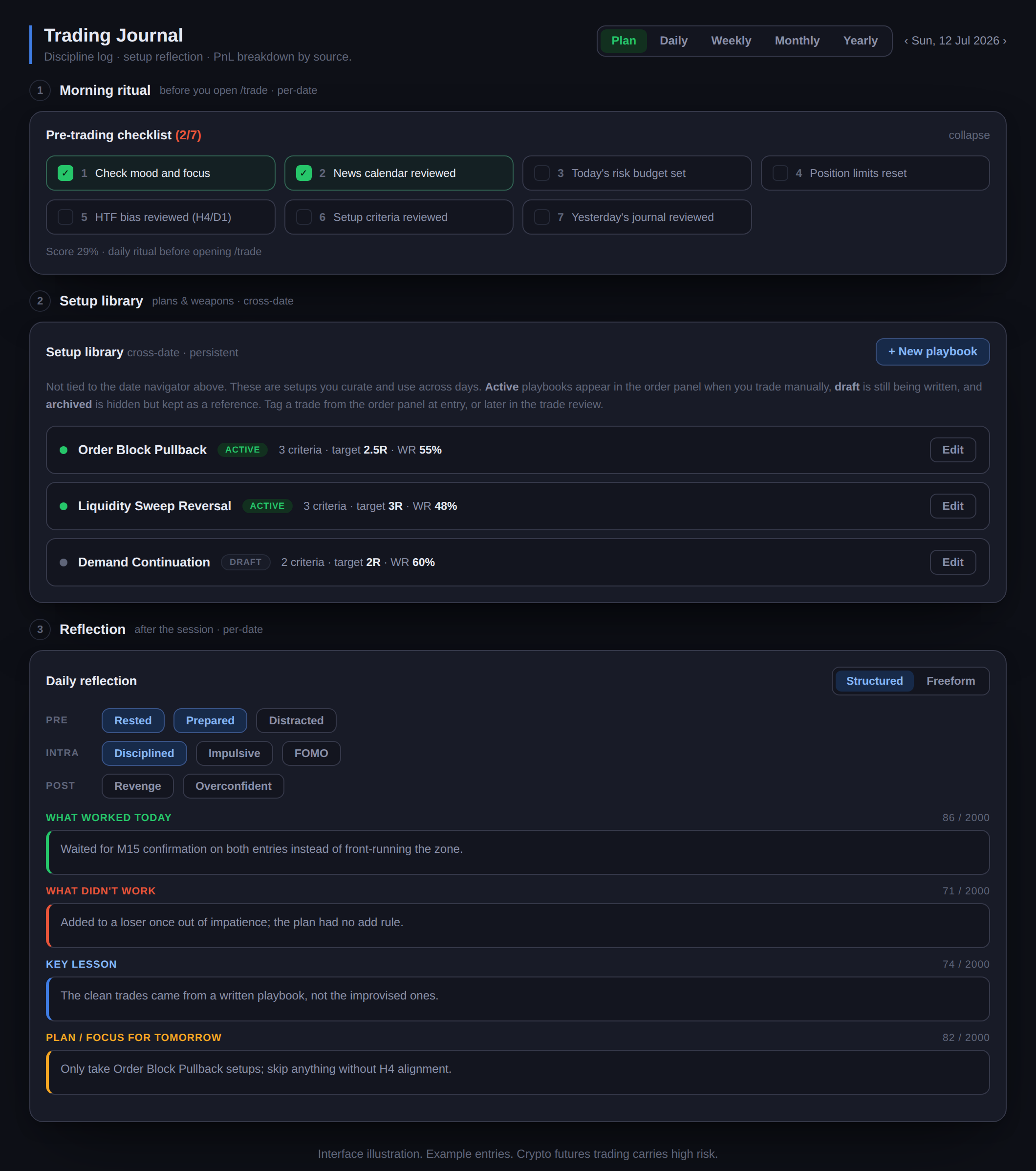
The Plan tab in the journal is where your trading plan lives: a pre-trading checklist to start the session with a clear head, a library of playbooks for your setups, and a daily reflection to close it. An active playbook appears in the /trade order panel, so you can tag a trade with a playbook at entry, and the journal measures each setup on its own.
1. Pre-trading ritual
Section titled “1. Pre-trading ritual”A short checklist before you open /trade, to start the session with discipline. It covers, for example: check mood and focus, review the news calendar, set today’s risk budget, reset position limits, review the HTF bias (H4/D1), review setup criteria, and review yesterday’s journal. The score is visible, so the routine is something you can measure.
2. Setup library: your playbooks
Section titled “2. Setup library: your playbooks”The setup library is cross-date and persistent, not tied to the date navigator. A playbook is a setup you document so you can use it again. Each playbook holds:
- Name. The setup’s name, up to 60 characters.
- Thesis. The entry conditions and why the setup works, up to 2000 characters.
- Criteria checklist. The conditions that must be met, up to 20 items.
- Target R and Target win %. Your expectation for the setup (optional).
- Status. Active appears in the playbook picker on the /trade panel, Draft is still being written, and Archived is hidden but kept as a reference.
- Screenshots. Example setups or a template, with an optional caption.
You tag a trade with a playbook straight from the order panel at entry, or later when you review the trade, so performance breaks down by strategy.
3. Daily reflection
Section titled “3. Daily reflection”Once the session is over, close the day with a reflection. The Structured mode gives you a frame: mood tags at each phase (PRE, INTRA, POST) and four review fields, namely what worked today, what did not, the key lesson, and the plan or focus for tomorrow. If you prefer, the Freeform mode gives you a single open space to write.
Beyond a single day
Section titled “Beyond a single day”Besides the Plan tab, the Daily, Weekly, Monthly, and Yearly navigators sum up your performance, including a PnL breakdown by source and by playbook. That way you see which setups actually work, rather than just how it felt.
Crypto futures trading carries high risk, including the possibility of losing part or all of your capital. Playbooks, checklists, and reflections are tools for discipline; the decision remains entirely yours.