Execution
When you are ready to enter, orders are executed directly to the exchange through your own API key. Trader Pending does not hold your funds; it forwards your instructions to your own exchange account.
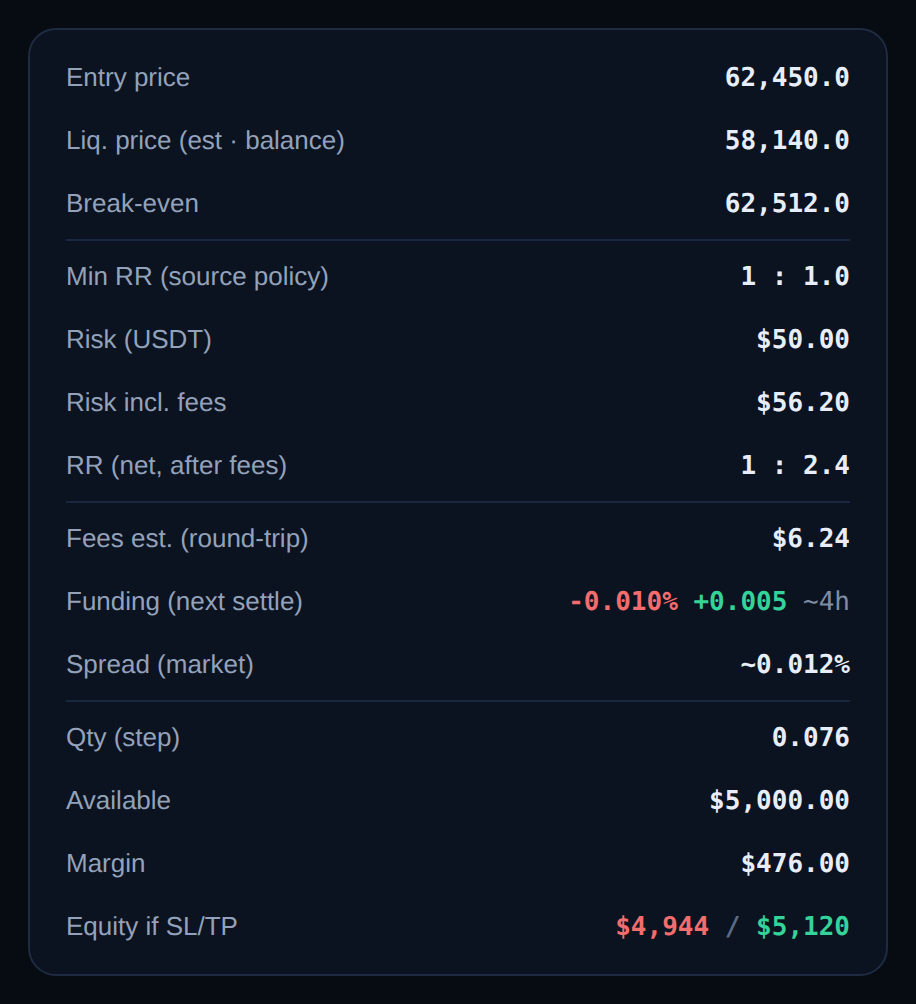
- Manual orders. Open a position through the order panel on the web, or through commands on Telegram for market, limit, and semi-manual zone orders. A position-size calculator helps you gauge risk before sending an order.
- Many exchanges, one flow. Support for major futures exchanges, including Bybit, Binance, OKX, Bitget, KuCoin, Gate.io, MEXC, HTX, and BingX. Each pair is executed on the exchange you choose.
- Switch exchange in one click. Once several API keys are connected, change the active exchange from the picker in the navbar. You execute on the chosen exchange right away, with no tab switching or settings changes.
- Stop-loss on the exchange. The stop-loss is placed directly on the exchange, so it stays in effect even if the bot connection drops. Take-profit runs automatically, including partial closes.
- Execution safeguards. Protection against duplicate orders and automatic leverage adjustment help keep execution clean.
- Signal webhook (optional). Connect alerts from your TradingView strategy; when an alert fires, the bot executes an order according to the instructions you send.
Risk you calculate, not risk imposed
Section titled “Risk you calculate, not risk imposed”Risk management is the layer that most decides whether an account survives, so the tools for it sit on every order, not as an afterthought.
You can size a position from the percentage of capital you are willing to risk per trade, up to 10%. The 10% ceiling is deliberate: beyond it, sizing is no longer about managing risk. The point is to keep the decision calculated and to stay clear of the all-in trade that can burn an account on a single mistake. Even so, the tool is not mandatory. You remain free to set size directly, including as large as you want if that is your choice.
Stop-loss and take-profit can follow ATR, the market’s actual range, rather than a fixed distance you guess at. When the market is calm, stops tend to sit tighter; when it is volatile, wider, so a position is neither swept away by small noise nor left over-exposed. The risk-reward ratio is always shown before an order goes out, with 1:1 as a baseline reference; if a setup’s reward is worth less than its risk, you are told.
All of this is a tool, not a rule. Trader Pending provides the means to be disciplined and shows the consequences honestly, then leaves the decision entirely to you.